
You know the feeling. It’s 7 pm. The sun is gone. Your sofa looks like an offer you shouldn’t refuse. A rom-com plays in the background. Then the hero smiles at a camera like he owns your Saturday night. Cue predictable music. Cue predictable longing.
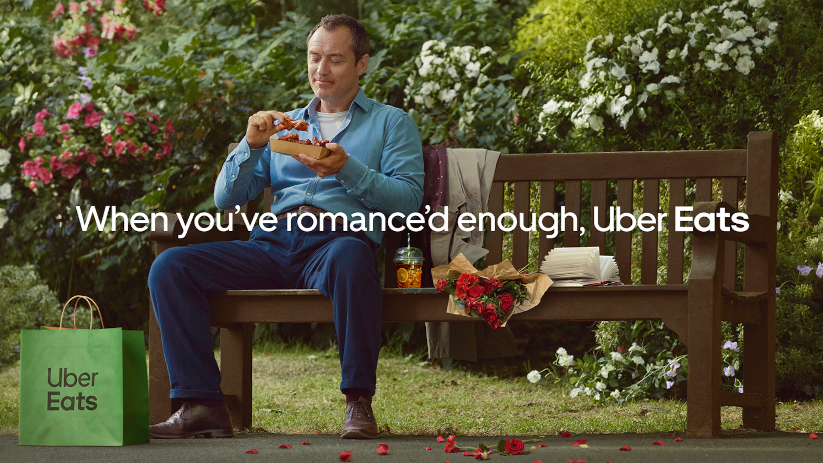
Now imagine that hero saying, out loud, “No. I’m done with this.” Then he orders chicken wings and eats them with sauce all over his face. That’s the new Uber Eats ad starring Jude Law. It’s short, funny, and honest in a way big budget ads sometimes forget to be. And it matters, because the ad quietly does two things any marketer would love: it makes people laugh, and it makes them see Uber Eats as permission to switch off and enjoy a simple pleasure.
Quick fact checks up front: the spot is part of Uber Eats’ UK brand platform called “When You’ve Done Enough,” and the new instalment is titled Romance’d Enough. The creative work was developed with agency Mother and directed by David Shane. The campaign runs across TV, out-of-home, digital and social channels.
Setting the scene: why this felt necessary
The food delivery category has been screaming convenience features for years. Free delivery. Wide choice. Fast times. All useful. But in an ad-saturated world, repeating those functional lines gets fuzzy. Uber Eats decided to stop shouting features and aim for a feeling instead: permission to put your feet up after you’ve done a lot for everyone else.
That shift was already underway in Uber Eats’ recent creative work. The brand launched a broader platform that dramatizes moments when people have “done enough”, various public figures appear in roles that play on what they’re famous for, then choose downtime and food. The Javier Bardem spot (Evil’d Enough), framed the same idea for a different kind of typecast: the man who always plays the villain. The Jude Law film flips the rom-com typecast on its head.
Why does this matter? Because casting a well-known actor in a role that echoes their screen persona is shorthand. It gives the ad context with a single frame. The audience brings the baggage, the previous films, the posters, the memes, and the ad borrows that history to land a quick comic beat. That saves time, and time is expensive in a 30 or 60 second film.
The creative idea: self-humour plus shorthand
Let’s be blunt: Jude Law’s brand is the rom-com heartthrob. That’s not a slight. It’s an asset. The creative idea here is twofold and elegant in its simplicity.
First, use the actor’s public persona as a storytelling shortcut. You don’t need to explain why a random man is being chased by meet-cute moments; the audience understands instantly when it’s Jude Law.
Second, have the star poke fun at himself. Self-humour takes the glossy sheen off a figure and makes them resemble the rest of us. That move invites the viewer in. It says: the star is human, pleasure is fine, and ordering food is an earned, private treat.
When those two elements come together, shorthand plus self-parody, the ad earns three things: speed of comprehension, relatability, and earned media. You get recognition from the cast, laughter from the script, and headlines from the press cycle. The trade-off is small: you must get the casting right and trust the audience will accept the joke.
Production notes reinforce the idea. The piece is cinematic, a romcom palette, but camera choices and editing land on small, revealing beats: an awkward glance, a botched meet-cute, a resigned sigh. The punchline is simple and human: Jude orders Uber Eats and digs into messy wings. That contrast, high-gloss romcom setup and low-gloss, unbuttoned payoff, is where the humour breathes.

Execution: what the ad does and where it runs
The ad opens in a world full of rom-com cues, cozy bookshops, dog-walkers who smile at the lead, the classic chance-run-in with a charming stranger. Jude Law navigates these moments like a tourist in his own career. Each potential meet-cute expands into a gag, and each gag underlines the ad’s premise: the hero has had enough.
At the end, Jude chooses simplicity: comfort, and a messy box of wings just delivered. The final frame is intentionally domestic, him alone, enjoying something he doesn’t have to prepare. That’s the brand moment. It’s a simple substitution of emotional beats: swap longing for comfort. The tagline anchors the idea: when you’ve done enough, Uber Eats.
Media placement is straightforward and integrated. The ad rolls across TV, DOOH (out-of-home), digital video placements, and social channels. The OOH presence helps push repeat exposure during peak commute and shopping windows. Social content does the heavy lifting for shareability, short cuts, behind-the-scenes stills, and the celebrity moment all go social-first, which lets earned coverage pick it up fast.
Credits are notable because they show the level of craft: Mother as creative agency, David Shane directing, and O Positive as production partner. Those names signal an approach that treats a 60-second ad like a short film. That matters when working with an A-list actor; you need production that matches the talent.

The strategic logic: why celebrity + self-parody is a low-friction way to land meaning
Here’s the strategy in plain terms.
- Use celebrity to compress context. People already recognise Jude Law. That recognition is a fast way to explain genre and tone without exposition.
- Use self-parody to humanise. When a star jokes about their typecasting, the audience translates that as approachability.
- Use a simple, human payoff to connect to the product. The scene isn’t about technology. It’s about a small, well-earned reward.
Put together, those moves make the ad memorable and shareable. The casting creates immediate pressability. The script supplies the social clips and GIFable moments. The product moment is short and unmistakable: food arrives and the viewer understands how the service fits their life.
You want to avoid two mistakes when using this tactic. First, don’t let the star dominate the brand. If viewers walk away remembering only the actor and not the product, you’ve failed. Second, don’t over-explain. The compactness of the idea is the strength; excess narration kills it.
What the press and the industry said (and what that implies)
Immediate coverage came from the industry press and trade outlets. Adweek, Creative Review, Campaign Live and others ran pieces describing the ad, its director, and its place in the brand platform. The coverage has highlighted the cleverness of flipping typecast personas and praised the decision to choose self-parody over solemn celebrity endorsement.
A few industry write-ups also placed the new film in the context of Uber Eats’ ongoing UK platform. The brand has previously run a Bardem-led spot that used the villain persona to similar effect. That prior work helped set expectations, that Uber Eats would be using cultural shorthand in a series of star-led vignettes to own a specific emotional idea: downtime.
What does that press attention buy the brand? Headlines. Social shares. Clips that live beyond the paid flight and get picked up by culture writers. For brands with big media buys, that earned coverage multiplies the campaign reach at little extra production cost. In short: a well-cast, self-aware spot makes the media ecosystem work for you.
Numbers and the reality of measurement
Publicly available campaign-level performance numbers, such conversions, uplift in orders, and incremental revenue attributed to these ads, have not been released yet. That’s common for major brand campaigns; not every client publishes immediate ROI figures.
What we can rely on are two kinds of measurable things that were reported:
• Brand context and scale: Uber Eats has notable scale in the UK market. Reports around this wider platform noted that Uber Eats supports tens of thousands of merchants in the UK and reaches a large portion of the population. One write-up referenced that Uber Eats supports over 70,000 merchants in the UK and reaches around 90% of the population; the platform also marked a milestone earlier in the year with its one billionth delivery celebration in the region. Those are brand-level facts that establish why Uber Eats invests in big creative.
• Media pickup: within days of release, the Jude Law film earned coverage from multiple trade outlets and creative sites. That media attention amplifies reach beyond the paid channels. The outlets covering the spot were quick to highlight the self-parody angle and the roster of celebrity-led films in the broader platform.
If you need campaign ROI, the usual practical steps are the ones the brand likely uses behind the scenes: A/B creative testing, short-term uplift in app opens and orders in the ad flight window, and longer-term brand-lift surveys measuring consideration and affinity. Those measurements typically live inside the brand’s marketing dashboards and media agency reporting.
So: the public press tells us the campaign is creative and well-crafted. Public press also shows clear earned media. Hard business metrics are private at this stage.
Why this matters for marketers
Here’s the condensed argument: celebrity is expensive, but it pays when used as a storytelling shortcut that leads quickly to the product moment.
Three practical lessons from this particular work:
• Use persona, not presence. Cast someone who brings a shorthand. It reduces exposition.
• Make the star comfortable with the joke. Self-humour must feel authentic; otherwise it flops.
• Keep the product moment crisp. Stars can overshadow the brand. Don’t let that happen.
The Jude Law spot gets all three right. Law brings the romcom baggage. The script lets him laugh at that baggage. And the product moment is simple: food arrives, the star relaxes.

Six key takeaways we can take from this campaign
- Familiarity is speed. When you use a star whose public roles map to an idea, you save precious screen time explaining tone and context.
- Self-humour lowers the wall. If the celebrity can laugh at their image, audiences treat them like a neighbour, not an advertisement. That transfers warmth to the brand.
- Pay the craft tax. A-list talent expects craft-level production. Don’t cut corners on director, production design, or editorial. The details sell the joke.
- Press is free reach. Clever casting and a tight idea earn media amplification. That earned coverage multiplies the paid buy.
- Keep the product beat short. Place the product moment as the emotional release. Once viewers feel the relief the character feels, they understand the role of the brand.
- Be honest about metrics. If you want business proof, you must plan for measurement from day one: baseline KPIs, a media flight with test/control markets, and a post-flight lift study.
Final thoughts
The Romance’d Enough film is a tidy example of modern brand cinema. It is honest, funny, and confident enough to let its lead poke fun at himself. That trust, between star, agency, and brand, is the quiet ingredient that turns clever ads into moments people remember.
This isn’t a technical how-to. It’s a reminder: when a campaign is built on a clear human idea, the creative becomes a shortcut to emotion. Jude Law’s cameo is effective because it does what all great casting should do: it gives the audience a fast lens through which to see themselves wanting to rest. And when the brand delivers a promise that’s simple, a meal delivered when you need it, people register it. They laugh. They share. They order.
Bon appétit!