
The path to major success is rarely smooth. Forget the stories of instant genius. Real breakthroughs are forged in continuous, exhausting struggle. And few companies tell the story of struggle better than Dyson.
Dyson took the painful process of engineering failure, the endless cycles of frustration and expense, and turned it into its most powerful marketing asset. They don’t hide their setbacks; they celebrate them. This strategic focus on persistence created a premium brand. It’s a brand defined by expertise, high prices, and genuine, high-tech authenticity.

I. The Myth of the Easy Win: Where the Struggle Began
Every brand that changes the world starts with a problem everyone else just tolerates. For James Dyson, that frustration was personal. And it involved a household appliance.
The Annoyance That Launched a Brand
Be honest: How often have you lost patience with your vacuum cleaner? The bags get full, the suction drops, and the machine starts coughing dust. This flaw plagued the industry for decades. Market leaders like Hoover didn’t fix it because selling those disposable bags was hugely profitable. Why kill the cash cow?
This inaction created a massive opportunity. Dyson’s mission was simple: “Solve the problems that others ignore”. He sought a new technology, no bags, no filters, inspired by industrial cyclone machinery.

The Legendary Failure Count
The journey from a good idea (the cyclone separator) to a great product was brutal. It was a five-year ordeal of constant work.
The key to Dyson’s marketing genius is the specific, unforgettable number he gave the world. He didn’t just say, “I tried a lot.” He quantified his commitment: He created an astonishing 5,127 prototypes. Yes, five thousand, one hundred, and twenty-seven. That means he had 5,126 magnificent failures.
The founder himself shared the quote that defines the company: “I made 5,127 prototypes of my vacuum before I got it right. That means there were 5,126 failures. But I learned from each one”. This single story instantly flipped failure on its head. It wasn’t incompetence. It was proof of disciplined, relentless innovation.
Turning Pain into Profit
For most companies, 5,127 failed prototypes would mean a chaotic R&D department. For Dyson, it shows an unassailable technical barrier. This is the strategic brilliance.
Dyson spends a huge amount on R&D, around £9 million every week. High research and development costs are tough to explain, especially when your products are expensive. By sharing the staggering cost of the initial breakthrough, Dyson sets a precedent. The final, premium product must be expensive. The price tag isn’t about luxury materials; it’s about the immense R&D struggle. This calculation transforms high spending from a financial risk into an undeniable statement of quality. It proves they solve problems completely, no matter the cost.

II. An Obsession with Engineering: The R&D-First Model
The core belief in continuous failure and iteration is built into Dyson’s company structure. They see themselves as an engineering company first. Marketing only exists to explain the engineering achievements.
The Cash Commitment
Clare Mullin, a former Global Marketing Director, made this clear: Dyson is an engineering-led company, not a marketing-led company. This means the company doesn’t just invest; it pours cash into invention. Think about this: Dyson commits an incredible £9 million every single week to R&D globally. They do this to ensure their technological advantage never slips.
Even better, nearly half of their profits are immediately reinvested into innovation. They often sacrifice short-term financial return for technological dominance. The goal is always to invent what’s possible, not just make a slightly better version of last year’s model.
Looking ahead, their investment is accelerating. The company is currently executing a massive £2.7 billion investment plan to double their product range by 2026. This includes major work in robotics, AI, and battery technology.
The Builders vs. The Budget Police
Sir James Dyson’s philosophy openly criticizes typical corporate thinking, which often focuses on saving money now instead of expensive, long-term invention.
He passionately argues that innovation requires “builders, not bean-counters”. He views executives who prioritize cutting costs as potentially dangerous to the creative process. He suggests they often get jealous of the fluid, costly process of genuine invention.
The Cost of Long-Term Dominance
Dyson’s financial results prove this philosophy is real. In 2023, the company hit an annual revenue of £7.1 billion. However, recent figures show the strategic cost of this aggressive investment. Despite selling a record volume of products, over 20 million units, the profit before tax (PBT) fell significantly in the 2024 context.
This dip in profit, even with high sales, is not a market failure. It is the necessary outcome of aggressively reinvesting huge sums back into R&D. They are strategically absorbing costs now to build long-term dominance. This proves they have the “capacity to take pain” that the founder believes is essential for monumental success.

III. Visible Science: Justifying the Price Tag
The biggest hurdle for any expensive product is proving its value. Dyson’s solution is to make the engineering process, the direct result of the 5,127 failures, visible, easy to touch, and engaging.
The Transparent Revolution
Dyson products are designed to be elevated “objects of desire”. But their beauty isn’t just skin deep. The design celebrates functionality, ensuring every element highlights engineering excellence. The ultimate marketing move was the transparent revolution.
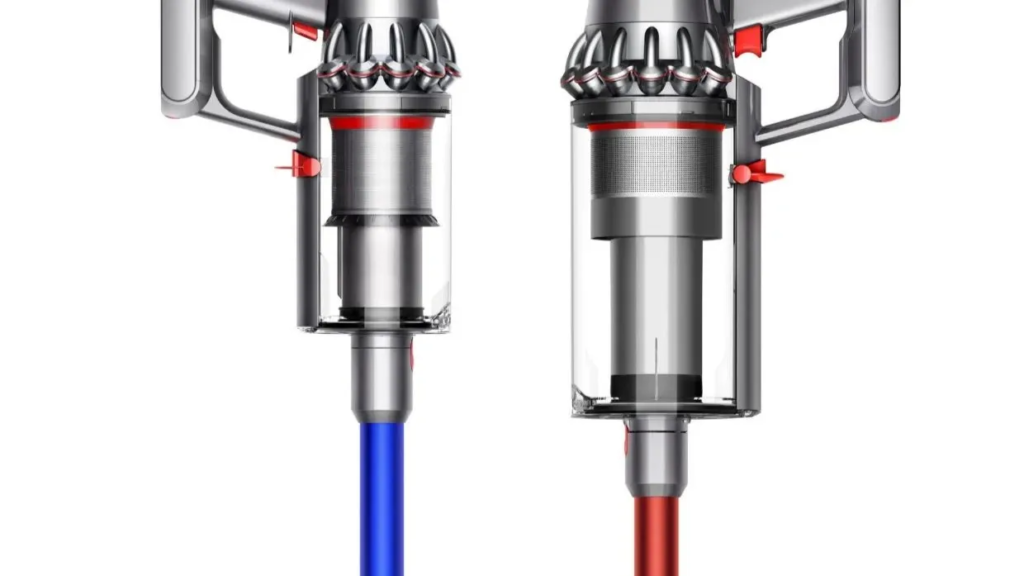
The clear bins and visible cyclones on the vacuum cleaners are the ultimate proof of technical superiority. By showing you the complex mechanism, the high-tech heart that took thousands of tries to perfect, Dyson achieves two things: First, you feel reassured that the premium price is tied to serious science. Second, you understand why it works better. The visible mechanism is the justification for the price.
Science as the Star
Dyson uses technical, science-driven stories to stand out. The bagless vacuum solved the infuriating, universal failure of loss of suction. This set the stage: Dyson solves fundamental problems with radical engineering.
This technical storytelling applies to everything they make. When they entered the beauty industry, they didn’t use fashion models alone. They focused on physics. The Dyson Airwrap Multi-Styler styles hair by using the Coanda effect to move air. Crucially, it styles without extreme heat, which avoids damage. The marketing appeals to the consumer who values verifiable performance over marketing fluff.
Proof in the Data
In a market full of subjective claims, Dyson offers objective data. They use measurement to prove how effective their most sophisticated products are. Take the Dyson V15 Detect Vacuum. It uses laser dust detection and Acoustic Dust Sensing. This technology actually measures and counts microscopic particles.
This transforms cleaning from a subjective feeling into a measurable science. You get scientific proof of a deep clean. This strategy targets the savvy customer who values performance and data. By providing objective evidence, Dyson transforms R&D costs into a verified, valuable consumer benefit.

IV. Beyond the Vacuum: The Breadth of Trust
The culture of iterative failure, validated by the 5,127 number, gives Dyson permission to launch complex products in completely different fields. The market trusts that Dyson will commit the immense engineering resources needed to make radical concepts work.
Securing the Invention
The initial success of the cyclonic technology, born from thousands of rejections, secured a massive intellectual property foundation. James Dyson holds a remarkable portfolio of 2,224 patents originating from 441 distinct patent families . This success proved that the brand’s commitment to solving the core physics of a problem, whether separating dirt or moving air, is a repeatable and transferable skill.
The Leap to Wearable Tech
The launch of the Dyson Zone air-purifying headphones is the most radical example of this trust. This product tackles two invisible, yet critical, modern stresses: noise pollution and poor air quality.
The device combines high-fidelity audio with air purification delivered via a detachable visor. Entering the wearable tech market is high-risk, but Dyson’s reputation, built on the authenticity of the 5,127 struggle and sustained by £9 million in weekly R&D, mitigates the risk. Customers know the intense technological investment required to make such a complex solution reliable has already been made. This extends the brand’s credibility into personal health technology.
The institutional commitment to R&D is clear in the sheer volume of intellectual property. The 5,127-failure ethos is a repeatable, institutionalized process.

V. Selling Persistence: The Emotional Connection
Dyson ensures its marketing campaigns are extensions of its R&D philosophy. The messaging transfers the emotional value of the 5,127 struggle to your personal journey.
The Difference is You
Campaigns like ‘The Difference is Dyson,’ featuring style icons like Deepika Padukone, are built on technical differentiation.
The core message says the technology delivers “real results”. The promise is performance without compromise, a promise that’s only credible because the R&D team has proven its commitment to fixing problems completely. The focus is on the power that proprietary technology gives you as the user.
Celebrating the Pioneers
A brilliant example of this emotional connection is the ‘Firsts’ campaign, which celebrated pioneering women for Emirati Women’s Day.
Dyson explicitly linked its engineering breakthroughs to women who embodied persistence, such as Marwa Al Mamari, the first Emirati woman aerospace engineer, and Ameni Esseibi, the first curvy model from the Middle East.
By celebrating these external ‘Firsts,’ Dyson achieves powerful resonance. They transfer the high-stakes, authentic value of their own 5,127 internal struggle onto you. Buying a Dyson product becomes more than a purchase; it’s an investment in a pioneering ethos. The brand suggests their products empower women to style hair with confidence, reflecting the same drive that charges these amazing careers.
Making Tech Human
The entire communication strategy, often channeled through the founder, emphasizes the necessary, human struggle of persistence and learning. By highlighting the years of frustration, the company successfully humanizes what could otherwise seem like cold, complex technology. Dyson takes the technology out of the lab and places it into your daily life, solving the small, everyday irritations that we all experience.

VI. The Persistence Playbook: Takeaways
Dyson’s story gives you a definitive blueprint for using innovation and authenticity to define your brand. The lesson is simple: failure isn’t something to avoid; it’s the raw material for distinction.
- Embrace Setbacks: Your first step is to create a culture that sees every mistake as crucial data collection. Dyson institutionalizes this view: “I learned from each one… So I don’t mind failure”. You must ensure your organization treats failure not as an ending, but as essential input to refine your direction.
- The Financial Reality: Real disruption requires accepting the financial hardship. Sir James Dyson notes that persistence is “by no means cheap”. Leaders must be ready for the strategic cost sacrifice, the dips in profit, to sustain aggressive, market-separating investment. This willingness to endure the pain is essential for mastery.
- Be the Radical Thinker: The Dyson philosophy actively encourages non-conformity. The founder suggests you should challenge established norms: “Initiate a failure by doing something that’s very silly, unthinkable, naughty, dangerous. Watching why that fails can take you on a completely different path. It’s exciting, actually”.
- Your Value Proposition: The Dyson model is a masterclass in justifying a premium price. Quantify Your Effort: Don’t just say you work hard; quantify it. Use specific, large numbers, like the 5,127 prototypes, to communicate the technical expertise embedded within your product. This builds trust and justifies premium pricing. Engineer for Transparency: Your product’s complexity should be a marketing tool. Design it to visibly celebrate the internal mechanisms. The visible engineering is the marketing itself.

The Definition of Success
The journey is long. Dyson worked for 15 years from the initial idea to the DC01 launch, and ten more years before the general market recognized the breakthrough. The ultimate lesson from the brand is profound: “Success is made of 99 percent failure”.
Maintain control over your invention, push it through every setback, and never lose sight of the original vision. That unwavering, persistent focus delivers “something to the public entirely new… which they cannot get anywhere else”. That unique offering is the hugely profitable payoff of the 5,127 Failure Playbook.