
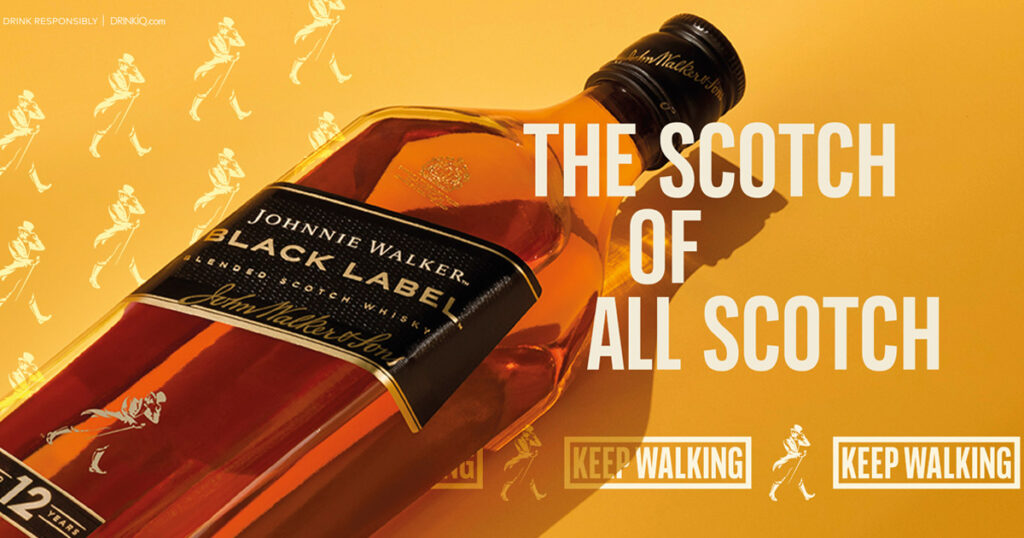
You know the feeling, don’t you? That moment when you look at a successful idea and wonder how it manages to survive time’s cruel sweep. Most marketing campaigns have the shelf life of milk. They peak, they curdle, they disappear. Yet, here we stand, examining an idea that has acted as a brand’s central element for over twenty-five years.
As a consultant immersed in strategy and brand development, I see the “Keep Walking” platform for what it truly is: a masterclass in strategic endurance. It is not just an advertising catchphrase. It is a fundamental “Walker mantra” that guides the brand’s entire global structure. It’s a philosophy that connects a product, Scotch whisky, to the most human of aspirations: the desire for forward motion, for constant improvement, for making today a little better than yesterday. This foundational idea is what allows Johnnie Walker, a brand with origins stretching back centuries, to maintain its commercial authority and deep cultural connection, even today. It represents a highly compelling case study for you and for any organization seeking to future-proof its relevance in a world that shifts faster than ever before.

I. The Architecture of Endurance: A Strategic Pivot from Stagnation
Imagine the situation in the late 1990s. Johnnie Walker was facing a very real business problem, a kind of existential slump. Whisky sales were declining, and the brand was viewed culturally as something your father might drink. It needed much more than a cosmetic update; it required a bold, strategic intervention to revitalize its market position and secure its future in the new millennium. If you’ve ever had to turn around a stagnant project or a declining revenue stream, you understand the pressure the brand’s leadership was under.
The solution was not found in listing the product’s attributes, but in embracing a universal human drive: progress. The strategic shift moved the brand away from merely celebrating its history to embodying an inspirational ethos of forward momentum and personal ambition. This transformation allowed Johnnie Walker to become a global symbol of striving, rather than remaining simply a traditional beverage supplier. It was a profoundly smart move.
The change wasn’t just spoken; it was visualized. The brand’s icon, the Striding Man, was literally given a new direction. He had been walking toward the left, which suggested looking back at the past. The agency flipped him. He was physically updated and repositioned to stride from left to right, explicitly symbolizing looking toward the future, ambition, and movement.
The Keep Walking phrase became the verbal articulation of this graphic command. It established a theme of overcoming grand adversity and the challenges inherent in success. The very first commercial, ‘The Walk’ (1999), featured the actor Harvey Keitel, focusing not on his fame, but on the vulnerability and professional fear he had to move past. Global Brand Director Jennifer English noted that this approach was innovative precisely because it chose to show “challenges and imperfections rather than just a glossy fabulousness”.
This honesty resonated immediately and massively with consumers. The core lesson here is clear: for any established brand, switching from a product-led approach to a purpose-led one provides the structural flexibility needed to weather economic shifts and appeal to different generations. The original investment was justified, not by short-term media attention, but by establishing this durable brand architecture capable of sustaining decades of commercial activity.

II. The Commercial Power of Consistency: Numbers and Results
You can have the most beautiful philosophy in the world, but if it doesn’t move the business forward, it’s just poetry. The “Keep Walking” campaign is famous because it delivered extraordinary commercial results, cementing its status as a gold standard in global marketing. The financial data confirms the success of that strategic shift back in 1999.
Just consider these results:
- Between 1999 and 2008, the foundational campaign generated an astonishing $2.2 billion in incremental sales. This fundamentally revitalized the brand’s position in the market.
- The platform’s profitability has been consistently maintained, reporting a global profit, Return on Investment (ROI) of €250 million by 2022.
- The campaign successfully halted an eight-year sales decline and subsequently surpassed the critical milestone of 21 million nine-litre cases globally for the first time ever.
- This sustained momentum confirms Johnnie Walker’s status as the “world’s number one Scotch whisky brand”.
That’s what I mean by commercial endurance. It’s proof that a clear, aspirational message can translate directly into billions in commercial value. Diageo, the parent company, views marketing spend not as a cost to be cut, but as a core tool for brand-led growth, and the numbers validate this strategic perspective. The prior success of the platform created a high internal benchmark that every subsequent campaign must meet: the potential to achieve similar effectiveness and maximize the impact of the company’s multi-billion-pound annual marketing investment.

III. The Strategic Elasticity: Changing the Context of Progress
The true genius of “Keep Walking” is its strategic elasticity. It never stands still. The core idea is fixed “Movement forward”, but the definition of what that means changes with culture. This prevents the message from feeling stale. You have to be prepared to reinvent your external identity without altering your internal character, and that is a difficult balancing act.
In the years before the most recent refresh, the platform shifted its focus to collective progress. This was a direct response to social changes, inspiring optimism and connection after global lockdowns, and celebrating groups breaking barriers.
A fantastic local example of this was the award-winning ‘Errata at 88’ campaign in Brazil. Johnnie Walker sponsored Alaíde Costa, a founding mother of Bossa Nova who had been obscured by racism and sexism, to perform at Carnegie Hall. This action corrected a historic wrong, cementing her cultural importance for new generations. This highly impactful local initiative earned a prestigious Cannes Lions Grand Prix. The success of this initiative confirms that a unified global voice can still achieve profound, culturally relevant local impact. he fundamental discipline, as Global Brand Director Jennifer English noted, is adaptation; the skill is figuring out “how you keep that core truth relevant”.

IV. The 2025 Reinvention: Progress Defined by You
By 2025, the brand recognized that cultural behaviors had shifted again. They knew they needed a fresh perspective to speak directly to a new generation.
They didn’t guess. They utilized deep, quantitative data, a concept I urge all my clients to embrace. The key strategic decision was driven by the McKinsey & Company’s State of the Consumer 2025 report. This research highlighted two crucial shifts in the modern consumer’s mindset:
1. A Focus on the Self: Consumers are increasingly dedicating free time to solo pursuits, personal hobbies, and self-expression. They are focusing inward, on their individual endeavors.
2. A Redefinition of Achievement: People are less likely to define success by traditional societal milestones, like marriage or homeownership, and instead place higher value on personal achievement and fulfillment.
The implication was clear: the brand had to pivot its narrative from the large, public concept of progress to the deeply personal, internal definition of advancement. You are defining success on your own terms, and the brand is recognizing that.
To ensure the new message was authentic, they took an unprecedented step in consumer research. The strategy was built upon extensive global social listening of over 97 million “keep” conversations. They used this massive data set, analyzed by Talkwalker, to define the emotional language of contemporary culture before creating the message. This minimizes creative risk, ensuring the message resonates immediately.
This colossal data set revealed six core emotional themes that now form the backbone of the campaign’s creative direction:
- Motivation: Fueling aspiration and initiative.
- Action: Rewarding continuous effort over stasis.
- Communication: Serving as a catalyst for sharing personal stories.
- Emotion: Acknowledging the non-linear, personal struggle of progress.
- Success: Championing individual metrics of achievement.
- Identity: Aligning the brand with self-discovery and uniqueness.
The word “keep” is the central focus of the new creative mandate. It reframes the mantra from focusing on the grand destination to the necessary action of Keeping Going. It’s a call for steady momentum and personal perseverance rooted in aspiration. This strategic reframing turns the single word “keep” into an invitation and a reminder that your personal experience of moving forward takes many forms.

V. Creative Mastery and the Micro-Aspiration
To connect with this new generation, Johnnie Walker utilized highly contemporary, culturally significant voices. The 30-second hero film was directed by Grammy-nominated ‘Child’ and produced by two-time Grammy Award winner Melina Matsoukas. These creative choices directly associate the brand with a modern, stylized aesthetic often seen in music videos for major artists. The film captures the simple, beautiful emotional truth that progress is rarely smooth, but is always personal.
Furthermore, the distribution strategy for the 2026 global rollout prioritizes modern, decentralized media. They are heavily focused on streaming, digital, paid social, and out-of-home (OOH). This reflects a pragmatic understanding that a polished 30-second TV spot must be effectively modularized for platforms like 6-second social spots. The successful practice of translating cinematic brand storytelling into efficient, short-form digital content is what maximizes commercial return.
The creative execution emphasizes the nuances of personal persistence through short vignettes. This narrative approach is perfectly designed for modular content across digital channels. By celebrating the “everyday keeps,” the campaign successfully democratizes the definition of “Progress”. The brand is no longer relevant just to the globally successful executive of 1999, but to the everyday consumer pursuing personal fulfillment.
The shift from large-scale ambition to small, sustainable movement is articulated through specific, relatable campaign phrases:
- “keep playing”
- “keep dreaming”
- “keep trusting”
- “keep searching”
This expansion of the target audience is vital for maintaining market leadership and continuously bringing in new, younger drinkers. It ensures the brand’s message aligns perfectly with the contemporary consumer who prioritizes self-expression and individual fulfillment. The continuous evolution of “Keep Walking” confirms that for iconic brands, longevity is achieved not through staying in one place, but through expertly managed, perpetual strategic progress.

VI. Lessons for Enduring Relevance: Your Strategic Takeaways
The Johnnie Walker story provides you with a powerful case study for your own professional or corporate endeavors. It is a set of principles for achieving perpetual brand relevance.
Preserve the Core Truth:
The single greatest factor in this brand’s survival is discipline. They have maintained the fundamental truth that the Striding Man symbolizes progress for over a quarter century. The goal is not to fundamentally alter your offering, but to possess the strategic skill to figure out “how you keep that core truth relevant”. This concept’s elasticity allows it to transition smoothly between macro, collective, and micro definitions of achievement without losing its identity. This is the necessary flexibility for enduring multiple generational shifts.
Use Data to Find Empathy:
The 2025 pivot underscores the absolute necessity of basing your strategy on robust, external quantitative data. The decision to focus on personal progress was driven directly by the McKinsey report and by analyzing 97 million social media conversations. If you are struggling to connect with new audiences, the key is to actively seek objective cultural data to define the emotional needs of that new generation. This minimizes the risk of creative failure by ensuring your message aligns perfectly with contemporary consumer emotional language. It stops you from operating in an echo chamber.

Embrace the Commercial Power of Purpose:
The enduring success proves that a purpose-led brand idea is a superior business asset. This brand idea generated $2.2 billion in incremental sales. It achieved a profit ROI of €250 million. It won a Cannes Lions Grand Prix for cultural relevance. The commercial returns are staggering, confirming that investment in a strong, inspirational message is a core lever for growth, not a cost center.
Every day, you are presented with opportunities to move forward, to keep striving, to choose the slightly better path. Whether you are leading a global organization or building your personal reputation, the message is the same. The next step is always the most important one. Take it.
Keep walking.