Every holiday season, fast-food places try to win us over with sappy ads and big discounts. But in 2025, one brand decided to rip up the playbook. They didn’t just join the holidays; they let the Grinch, a 68-year-old green trouble-maker, take over the whole company.
The result? It wasn’t just a hit; it was a masterclass in modern brand strategy.
The McDonald’s x The Grinch campaign was a perfectly executed strategy that used nostalgia, humor, merchandise, and smart operations to achieve a significant cultural and sales win. This campaign proved that the Quick Service Restaurant (QSR) industry’s future isn’t about the lowest price, it’s about the richest emotional connection.
This is the story of how McDonald’s handed the keys to the kingdom to the Grinch and secured the holiday crown.
The Strategic Context: Why McDonald’s Needed the Grinch
To understand the genius of The Grinch Meal, you first need to appreciate the strategic pressures McDonald’s faced in late 2025. This collaboration was born out of necessity to solve a critical problem plaguing the entire QSR sector.
The Ghost of Grimace and the QSR Dilemma
The Grinch Meal was a calculated follow-up to the viral success of the McDonaldland Adult Happy Meal, which launched in August 2025. The Grinch strategically capitalized on that proven momentum, cementing the Adult Happy Meal format as a reliable, recurring cultural event.
The need for such disruptive, IP-driven campaigns became urgent due to a persistent industry paradox:
- The Price Problem: Data showed that QSR combo meal pricing increased by 14% year-over-year in 2025. Consumers saw higher prices, even as brands tried to offer more value promotions.
- Price Cuts Failed: Generic “value” no longer feels like true value; it feels like marketing spin. McDonald’s relaunched its Extra Value Meal, but that initiative failed to deliver meaningful traffic gains, with foot traffic dropping 4.4% year over year. This proved that simple, basic value offerings are no longer enough.
- The New Plan: The QSR war is no longer about who can offer the cheapest commodity; it’s about who can generate the most emotional currency. Collaborations that tapped into pop culture, like the prior Minecraft Movie Meal, generated consistent, strong traffic boosts. McDonald’s realized they needed to make the transaction an event. The decision was to increase the perceived value through exclusive collectibles and deep nostalgic emotional ties, moving the customer’s motivation from mere cost-saving to the powerful psychological drivers of collecting and the Fear of Missing Out (FOMO).

The Uncomfortable Reality of the 2025 Consumer
The campaign’s timing was perfectly calibrated to prevailing economic and emotional anxieties.
- Economic Anxiety: The high cost of living remained dominant, with the cost of food away from home rising 3.9%. This anxiety is amplified during the holiday season.
- Nostalgia as Comfort: To counteract this distress, McDonald’s deployed nostalgia, a powerful psychological tool. Research confirms that nostalgia makes people feel secure and comforted, offering an elevated mood state. These emotions become a coping strategy against distress, especially during instability.
- The Grinch’s Validation: The Grinch’s mischievous persona offered a unique form of consumer validation: the permission to reject forced holiday happiness. By framing the promotion as the Grinch being the mischievous saboteur of the season, McDonald’s acknowledged the stress, chaos, and financial burden associated with Christmas. This self-aware, human tone cut through the glut of overly sentimental, traditional holiday advertising.
Deconstructing The Grinch Meal: Operational Genius Meets Merch Mania
The genius of the Grinch campaign is found in the elegance of its execution. It combined high cultural buzz with low operational risk.
The Product Formula: High Buzz, Low Operational Risk
The Grinch Meal was deliberately built on existing, high-volume products.
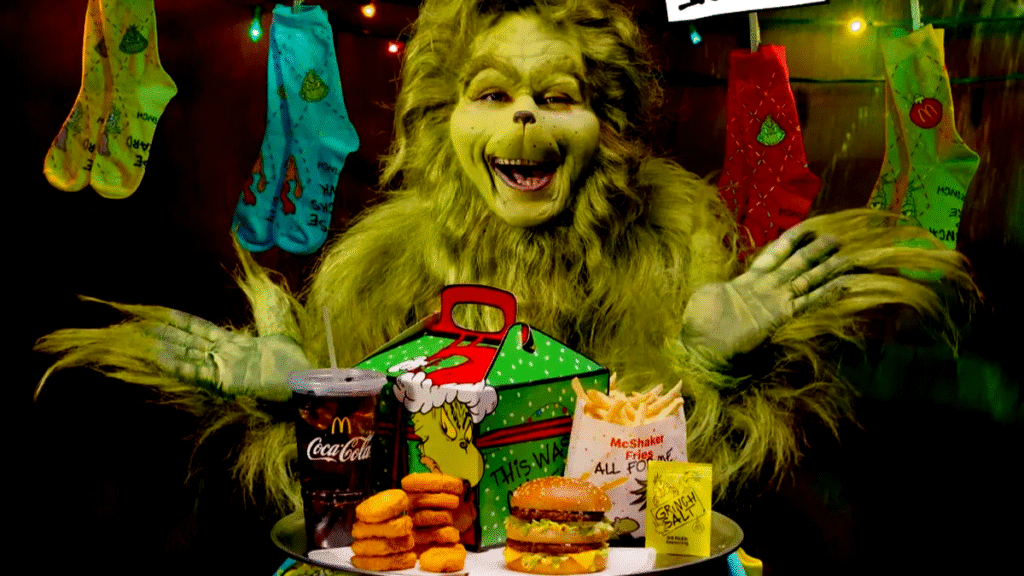
- Core Meal: It offered a choice between a Big Mac or 10-piece Chicken McNuggets, plus a medium drink. These are Standard Kitchen Units (SKUs) requiring zero additional training. This strategic restraint ensured the promotion could be rapidly deployed system-wide during the holiday rush.
- Novelty: The novelty was reserved entirely for two elements external to the core food preparation process: the fries and the merchandise.
The Dill Pickle Revelation: Multilayered Nostalgia
The sole menu innovation was the Dill Pickle “Grinch Salt” McShaker Fries.
- The ’90s Throwback: The McShaker Fries were a known ’90s relic, precisely targeting older Millennials and Gen Z adults.
- Operational Brilliance: The seasoning, the “Grinch Salt,” was provided as a separate packet. This shifted the complexity of mixing from the busy kitchen staff to the consumer, who completes the fun, tactile act of sprinkling and shaking.
- Built-in Virality: Dill pickle is deliberately polarizing and mischievous, perfectly matching the Grinch’s chaotic personality. Polarizing menu items guarantee immediate User Generated Content (UGC) and social media chatter.

The Sock Strategy: Merchandise as a Margin Driver
Each Grinch Meal came with a pair of fuzzy, limited-edition Grinch socks.
- Adult Collectible: The socks were positioned as the “grown-up parallel to toys”.
- Driving Repeat Visits: They came in four distinct, collectible designs. This inherent scarcity incentivized consumers to purchase the meal multiple times to complete the set.
- Margin Expansion: The high perceived value of IP-driven merchandise (collectible socks) vastly exceeds its actual production cost. The socks became the primary psychological anchor that validated a premium price point, driving both sales volume and higher profit margins.
The Psychology of Chaos: Why Grinch Humor Was the Perfect IP Match
The collaboration was a resounding success because McDonald’s borrowed the Grinch’s entire disruptive personality.
Ceding Control: The Masterclass in Anti-Sentimentality
The entire campaign was framed as the Grinch literally “taking over” McDonald’s. The brand, in collaboration with Leo UK, launched “McDonald’s Christmas Grinched,” positioning the Grinch as the mischievous saboteur of the festive season.
- Cutting Through the Noise: The company allowed this spirit of chaos to permeate all channels. They turned over their social media, the Times Square billboard, and even official press release duties to the Grinch.
- Authenticity through Vulnerability: This radical strategy was designed to “cut through the wall of feel-good Christmas ads”. By allowing the Grinch to playfully “mess with” the menu, McDonald’s signaled that it prioritized cultural relevance and fun over rigid corporate branding rules. Vulnerability and ceded control generate more authenticity than flawless corporate execution.

The Humor and Humanization Factor
The Grinch’s appeal lies in his relatability during times of high stress.
- Emotional Release Valve: The campaign’s self-aware humor offered a necessary emotional release valve for consumers. It was designed to bring “light-hearted relief and nostalgia… amidst the chaos of the festive season”.
- Comprehensive Integration: The brand’s decision to “humanize the experience” meant adopting the Grinch’s voice, humor, and look everywhere. This included:
- Dr. Seuss-style rhymes on packaging.
- The overwhelming use of bright Grinch greens.
- Hand-drawn textures across digital menu boards.
- McCafé Holiday Cups featuring designs of the Grinch, Max, and Cindy Lou Who.
- Masterful Psychology: The promotion felt like an immersive, mischievous event. The timing (the end-of-year “temporal landmark”) and the nostalgic IP addressed the consumer need for belonging and helped combat social anxiety amplified during stressful holiday periods.
Execution: The Full-Funnel, Integrated System
The Grinch campaign was a full-funnel, integrated system that ensured the Grinch was inescapable across every relevant media channel.
System, Not Spot: Pervasive Placement Strategy
The campaign utilized a clear phased approach.
- Tease and Reveal: A “tease phase” built anticipation across social, Out-of-Home (OOH), and AV, showing a mysterious figure meddling with McDonald’s. This was followed by a strategic reveal, including a special build unveiling the Grinch’s “Master Plan”.
- Ecosystem Integration: The crucial strategic shift was in budget allocation: moving away from solely relying on linear television and investing heavily in ecosystem integration. Placement included:
- Broadcast, sports (during NFL and NBA games).
- Streaming video (strategic paid placements on Hulu and Roku holiday hubs).
- Audio (Spotify playlists).
- Mobile gaming and app experiences.
- Holistic Reach: The campaign’s reach was designed to be holistic, turning the collaboration into a “full-funnel holiday presence rather than a single promotion”.
The Gaming Program: Meeting the Audience Natively
The most forward-thinking element was McDonald’s first holistic gaming program. This directly addressed the key young adult demographic that lives natively on platforms like Twitch.
- Creator-Led Content: The initiative involved collaborating with popular Twitch creators, including Sydeon, TinaKitten, Happyhappygal, and CyYu, for holiday livestreams. These broadcasts included chat-voted challenges and branded surprises designed to incorporate the Grinch’s chaotic persona directly into genuine, interactive content.
- Purchasing Authenticity: This shift in budget allocation, from generic broadcast media to native ecosystem integration, purchased authenticity. Content created by these popular creators resonates deeper than a traditional ad break, successfully transforming the ad into a cultural event.

Results and Key Takeaways
The McDonald’s x The Grinch 2025 collaboration provided strong validation for the IP-driven, nostalgia-focused strategy.
- Sustained Momentum: McDonald’s had already reported strong financial performance in Q3 2025 (Global comparable sales increasing 3.6% and Global Systemwide sales growing 8% over the prior year). The Grinch campaign was designed to carry that weight through the competitive Q4.
- Cultural Velocity over Discounting: Data proved that culturally resonant collaborations like the Minecraft Movie Meal delivered consistent, meaningful traffic boosts, whereas the Extra Value Meal relaunch resulted in traffic drops. The Grinch followed the successful blueprint, proving that the unique combination of novelty, scarcity, and emotional ties drives traffic far more effectively than basic price cut.
- Maximized Urgency: The limited-time structure of the Grinch Meal (“while supplies last”) maximized urgency and leveraged the high social buzz into immediate, measurable foot traffic.

Five Key Takeaways I Learned From the Grinch’s Chaos
This campaign laid bare five undeniable lessons for achieving scalable marketing success in the modern era:
- Nostalgia is the New Value Proposition: Emotional value beats economic value when scarcity is involved. The emotional security from familiar Intellectual Property and throwback products (like ’90s Dill Pickle Fries) provides a stronger justification for premium pricing than any coupon.
- Operational Elegance Drives Scale: The best LTOs maximize cultural buzz while ruthlessly minimizing operational strain. By keeping the collectible item (socks) and novelty element (seasoning packet) external to the core food preparation process, the promotion was rapidly scalable nationwide. Limit complexity to the packaging and the premium item; keep the kitchen absolutely simple.
- Give Your Fandom Permission to Be Human: The strategic decision to allow the Grinch to be chaotic was an acknowledgment that the holidays are stressful, expensive, and overwhelming. Authenticity in 2025 often requires vulnerability. By embracing its “inner Grinch,” the brand gave its audience permission to feel the stress, which rewarded McDonald’s with deeper connection.
- The Merch is the Message (and the Margin): The fuzzy Grinch socks were the primary engine of the Adult Happy Meal strategy. The collectible, giftable nature of the merchandise is the dominant psychological driver for repeat visits. Focus on high-quality, wearable, or shareable merchandise to justify premium pricing and create immediate social currency.
- Stop Creating Ads, Start Building Ecosystems: The Grinch campaign was a multi-platform, pervasive system integrated across sports broadcasts, streaming hubs, and niche channels like Twitch. The future is predicated on the ability to create platform-native content. The single hero film is dead; the continuous, chaotic, integrated ecosystem is the new standard.

Conclusion: The Future of Brand Partnerships
The McDonald’s x The Grinch 2025 campaign will undoubtedly serve as the industry blueprint for winning the holiday season without defaulting to desperate, margin-killing price wars.
By deploying potent nostalgia as a psychological comfort mechanism, leveraging self-aware and disruptive humor, and strategically building a robust, multi-channel media ecosystem, McDonald’s successfully transformed its most standard menu offerings into a highly coveted, scarce, limited-time cultural event. The campaign proved that disruption, emotional connection, and operational intelligence are the only true drivers of scalable QSR success.
The Grinch didn’t just stage a takeover; he offered the entire quick-service industry a highly profitable lesson in cultural relevance.