
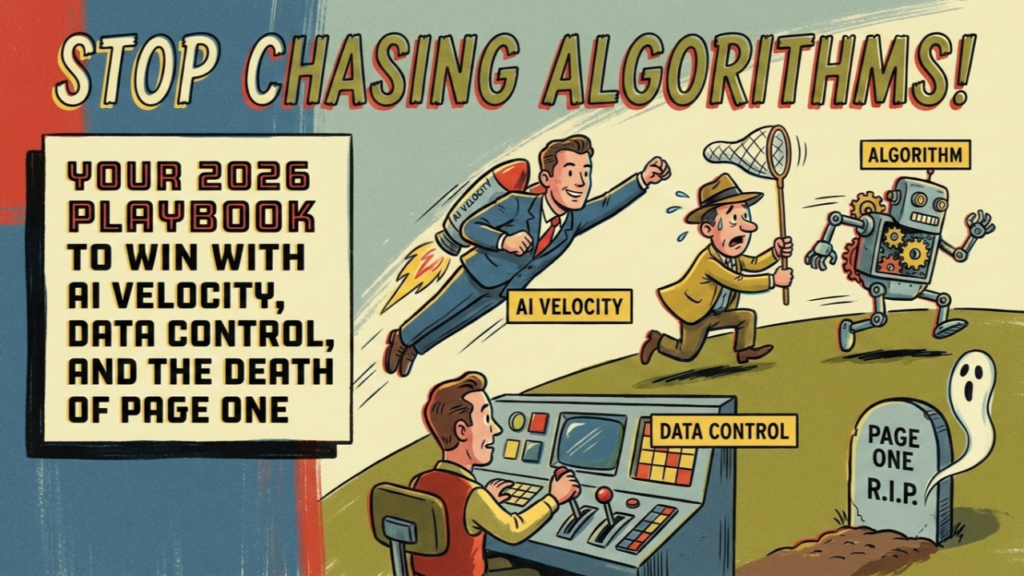
Stop Chasing Algorithms: Your 2026 Playbook to Win with AI Velocity, Data Control, and the Death of Page One
Let’s be honest. If you’ve been in marketing for any length of time, you’ve heard the phrase, “This time, it’s different.” I’ve heard it, you’ve heard it. We heard it with the internet, then mobile, then cloud computing. They were all transformative, yes, but 2026 is bringing a change that is fundamentally, structurally, new.
I’ve spent years guiding brands through digital transformations, and what I’m seeing now isn’t an upgrade. It’s a complete redesign.
The old playbook, where you had time to get the technology right, optimize the process, and then scale, is dead. It has been replaced by a mandate for instant velocity, the existential challenge of Generative AI, and a core demand for data sovereignty. In short, if you’re still thinking about adding AI as a “tool,” you’ve already lost the game.

Part I: The Compression of the S-Curve: Why Velocity Is Your New Strategy
Do you remember how long it took for the internet to hit its stride, or for everyone to truly adopt mobile? Years. We had breathing room.
Today, that breathing room is gone.
This technological moment is defined by the compression of the S-curve. The distance between a technology’s emergence and its mainstream adoption is collapsing. If your organization is built for slow, sequential, incremental improvement, you simply cannot compete with competitors who are operating in continuous learning loops.
This isn’t about having the best technology. That will soon be commoditized. The true competitive advantage has shifted entirely to what I call Organizational Metabolism.
- How fast can you ingest new tech?
- How fast can you redesign your core processes?
- How fast can you execute?
The gap between market leaders and organizational laggards is growing exponentially because innovation compounds. Every new AI capability makes the next one arrive faster. The primary mandate for marketing executives right now is an organizational design challenge, not a MarTech project.
You need the managerial courage to redesign core processes, not just automate the existing, slow ones.

Part II: The AI Imperative: From Tools to Agents
The biggest headline for 2026 is the adoption of Agentic AI. Think beyond a chatbot writing an email. Agentic AI refers to systems capable of autonomously executing complex, multi-step tasks, they are the future of marketing workflow automation.
The numbers are staggering, but they underscore the urgency: The global market for agentic AI is predicted to reach $45 billion by 2030. This isn’t theoretical; it’s an infrastructure investment.
The Hidden Cost of Inference
Here is a number most CMOs aren’t budgeting for yet: $200 billion. That’s the projected value of the dedicated AI chip market in data centers. Why does this matter to a marketer?
The running of AI models, what we call inference, is forecast to account for two-thirds of all AI compute demands by 2026. The most specialized and powerful AI models require immense, centralized computational power.
This means that while basic AI agents will be free or cheap, access to the high-performance, proprietary models you’ll need to beat the competition will be costly and centralized.
Your Action Item: You must budget not just for software licensing, but for the high-capacity cloud compute resources required to fine-tune and run proprietary models at scale. Recognizing and budgeting for this hidden cost of inference is a non-negotiable part of high-performance AI deployment.

Part III: The Visibility Crisis and the Rise of GEO
I talk to marketers every day who are still obsessed with ‘ranking on page one.’ I have to break the news: Page One is dead.
Consumer behavior is shifting from simple fact-finding to dynamic exploration. As users pivot from the traditional Search Engine Results Page (SERP) to the synthesized responses provided by AI Overviews, Copilot, and chatbots, the strategic objective has changed completely.
Inside the Answer is the New Front Page
The new mandate is to show up inside the answer synthesized by the generative engine. For brands, getting cited by the AI is the new measure of share-of-voice. If the AI fails to mention or quote your content, you are functionally invisible, you’re on the unvisited back page of the internet.
This is why we must now focus on Generative Engine Optimization (GEO).
GEO is the strategic practice of optimizing content specifically for consumption and utility by AI-powered search engines and chatbots. It shifts the focus away from tactical keyword-stuffing and toward creating content the AI can trust, understand, and use when synthesizing accurate answers.
The GEO Playbook: Optimizing for Synthesis
I have observed the citation patterns of major AI platforms. Here’s what I’ve learned, and what must guide your GEO strategy:
- Authority is Non-Negotiable: Google AI Overviews (SGE) heavily favors long-standing, high-authority domains. Your content must be factually authoritative. Period.
- Architecture for Extraction: AI engines like Bing/Copilot prefer fewer, concise citations.
- You need structured content: clear lists, definitive how-to guides, and immediate knowledge extraction points. Stop writing 2,000-word rambling essays. Write structured answers.
- The Power of the Informal: Surprisingly, platforms like YouTube and Reddit are heavily cited by both ChatGPT and Google SGE. If your B2B technical content isn’t being broken down into accessible, authoritative videos or engaging community posts, you’re missing out on citation opportunities.
Case in Point: Real Results with Targeted GEO
We are already seeing the power of this shift. One Fintech company, through targeted optimization and data-driven insights, the essence of GEO, increased its signups by a whopping 227.9% in just six months. This isn’t magic; it’s engineering content to be cited by the AI.
This is why your SEO team must stop reacting to algorithm updates and start anticipating user intent, moving toward predictive content ecosystems. AI can now analyze user journeys and recommend collections of related topics that establish true domain authority. You are no longer playing catch-up; you are positioning your brand as the thought leader who anticipates the future.

Part IV: Data Sovereignty, First-Party Fuel and Clean Rooms
The post-cookie world is here, and it’s the best thing that ever happened to performance marketers. Why? Because the reliance on shaky, temporary third-party data is over.
Data ownership is now foundational to the marketing stack.
High-quality, consented first-party data is the necessary signaling mechanism that feeds the sophisticated AI models required for sustained growth. The strategy must pivot entirely to developing behavioral cohorts founded on owned assets: loyalty sign-ups, interactive quizzes, strategically gated content.
The Privacy Safe Haven: Data Clean Rooms
As first-party data becomes your strategic asset, the challenge becomes: How do you collaborate and measure securely with partners without compromising customer privacy?
The answer is the Data Clean Room (DCR). DCRs (like those provided by AWS or Snowflake) offer a privacy-safe infrastructure. They allow you to securely link your brand data with partner data, say, a retailer’s transaction data, to optimize media spend based on real sales, without ever exposing raw customer information. This ensures you maintain data sovereignty while gaining the signals Gen AI models need for accurate cross-platform targeting and measurement.
The urgency here is tied to personalization. Historically, true one-to-one personalization at scale was prohibitively expensive due to the massive cost of creating and maintaining thousands of content variants.
Generative AI has solved this economic barrier. By automating the creation and maintenance of dynamic content, Gen AI makes true one-to-one personalization feasible and cost-effective. But this system runs on fuel, and that fuel is your clean, compliant first-party data, securely managed in a DCR.
The New Measurement Paradigm
With AI agents driving complex, automated engagement paths, simple last-click attribution is unreliable. You must move to smarter measurement:
- Incrementality Testing: To prove that your AI campaigns are causing new business, not just claiming credit for existing sales.
- Marketing Mix Modeling (MMM): To accurately attribute long-term business outcomes to specific, large-scale, automated investments.
- Lifetime Value (LTV): To ensure your focus is on creating valuable long-term customers, not just cheap clicks.

Part V: The Human Element: Treats, Nostalgia, and Micro-Communities
It’s easy to get lost in the wires and algorithms. But remember, we market to humans. And in an environment of sustained economic uncertainty and global chaos, consumer psychology is shifting profoundly.
1. The Power of Treatonomics
In a chaotic world, long-term aspirational goals feel distant. Consumers are prioritizing present wellbeing. This shift has fueled ‘Treatonomics’: the ‘little treat culture’. It’s a psychological antidote to volatility. Consumers are still spending, US retail is expected to exhibit strong growth, but they are redirecting their wallets.
Your Strategy: Brands and retailers must focus on improving the value and quality of products. For luxury goods, this may mean strategically promoting less-expensive variations, like an Eau de Cologne over a pricier Eau de Parfum, to offer that crucial psychological reward with a lower financial barrier to entry.
2. The Nostalgic Remix
In search of comfort and identity, nostalgia has become a potent economic engine, leveraged across beauty, gaming, and apparel. But here’s the key: You can’t just recycle old ads.
The goal in 2026 is to create new memories from old ones. It requires a strategic audit of your brand’s most potent nostalgic assets (a retired logo, a classic jingle) and then collaborating to “remix” the past into a new product or experience that feels both familiar and fresh. This engages today’s digitally-native creator audience, who want participation, not just consumption.
3. The Maturation of the Creator Economy
Investment in creator content is surging. A net 61% of marketers plan to allocate more budget in 2026. However, the pressure to prove ROI is intense.
The market has spoken: Micro-influencers are widely expected to outperform traditional celebrity endorsements. Why? Because people are moving away from crowded, impersonal algorithmic feeds and gravitating toward micro-communities where they can find meaningful belonging.
Your Strategy: Shift from isolated, one-off executions to long-term creative platforms. Set clear guardrails and success metrics, but give creators the autonomy to maintain authenticity. Over-directing kills the spark; under-briefing risks brand dilution. Win by showing up consistently in these authentic spaces, providing tangible value, and engaging with relevance.

Part VI: Defending Trust and Championing Value
In a world where Gen AI is projected to create 90% of all online content by 2026 , trust is the only non-replicable competitive asset.
The Industrialization of Misinformation
Generative AI allows for the cheap, rapid, and industrial-scale proliferation of sophisticated deepfakes and false narratives. This requires an industrial-scale defense.
Trust and authenticity are the only enduring competitive edges. You must implement robust monitoring systems to track narrative authenticity and separate the verifiable signals from the algorithmic noise.
Inclusion Drives Loyalty
Inclusion is not a compliance issue; it’s a growth engine. As a consultant, I’ve seen this mandate distilled down to a simple, human equation: Inclusion = Loyalty = Advocacy.
Consumers value companies who promote diversity, 65% of people globally feel this way. When you lead with certainty about your values and mandate authentic representation across your creative, you build loyalty. This ensures you build advocates who stick with you through challenging economic cycles. It feels good to be included; it feels better to be embraced.
Sustainability Through Tangible Value
Consumer skepticism toward abstract “green” claims is at an all-time high. In 2026, the most effective “green marketing” may entirely omit the word “green”.
The market is shifting toward affordability and practicality. You must prove sustainable value through quantifiable, tangible benefits that align with the consumer’s wallet and lifestyle.
Examples: Emphasizing superior materials, demonstrating extended product lifespan, or providing verifiable data on energy efficiency and durability. Sustainability is moving from a communications task to an operational imperative, finding the virtuous cycles between emissions reduction and revenue growth.

My 5 Key Takeaways
After years in the works and seeing this tectonic shift accelerate in real-time, here are the five most critical, personal lessons I’ve learned about navigating the 2026 imperative:
- Stop Automating Mediocrity; Start Redesigning with Courage: I realized that every AI investment fails if it’s merely tacked onto a broken process. The speed we need now demands that we, as leaders, have the courage to wipe the slate clean and restructure our fundamental workflows around continuous AI orchestration. Velocity isn’t a strategy; it’s the output of a well-designed organization.
- GEO is Now a Mandatory Investment, Not a Side Project: The shift from ‘ranking’ to ‘citation’ is an existential threat. I learned quickly that simply creating more content churned out by AI leads to a homogenization crisis. We must focus on Authority, Structure, and Trust to make our content citable by the generative engines. If the AI doesn’t cite you, you don’t exist.
- Data Sovereignty is the Cost of Entry for Personalization: You can’t build a hyper-personalized future on borrowed data. I learned that the investment in a robust, first-party data ecosystem and Data Clean Rooms isn’t a privacy issue, it’s the prerequisite infrastructure for Gen AI to deploy personalized content efficiently and at scale. Own your data, or watch your personalization efforts stall.
- Balance the Tech with the Human Need for ‘Treats’: It’s easy to focus on the next big tech trend and forget that consumers are tired, anxious, and seeking comfort. I learned that sometimes, the most sophisticated marketing strategy is the one that allows for a ‘little treat’, a strategic promotion of a smaller luxury or a meaningful moment of nostalgia.
- Fundamentals Remain the Undisputed Champions: All the AI in the world cannot save a poor marketing idea. I learned that the teams winning in 2026 are those who have built stronger muscles in marketing fundamentals, strong research, brave insights, and strategic thinking, and only then let AI breathe more creative life into those efforts. AI amplifies greatness; it doesn’t create it.

Conclusion: The Choice Is Now
The year 2026 isn’t a point on a roadmap; it’s a crucible. It will determine which businesses thrive and which become functionally obsolete.
We are no longer discussing if AI will change marketing, but how fast that change will happen. The performance gap between those who embrace this reality and those who hesitate will grow exponentially.
Your three non-negotiable strategic pillars must be:
- Velocity: Build an organization capable of continuous learning and rapid redesign.
- Generative Engine Optimization (GEO): Be the answer cited inside the AI response.
- Data Sovereignty: Fuel your hyper-personalization with owned, trusted, and compliant data.
This journey is complex, but it is also the most exciting opportunity we’ve seen in a generation. Embrace the complexity, find your courage to redesign, and let’s build marketing strategies that aren’t just ready for 2026, but that actively define it.