The Great Unbundling is Over. The Great Personalization has Begun.
If you’ve spent any time on LinkedIn lately, you’ve seen the shift. The “race to the bottom” that defined the 2010s, where airlines competed solely on who could offer the cheapest, most plain experience, has hit a wall. In 2026, the industry is no longer recovering; it is maturing.
We are witnessing a “K-shaped” recovery in real-time. On one side, airlines that failed to innovate are being swallowed by rising fuel costs and labor demands. On the other, the leaders, Delta, United, Emirates, and even a reinvented Spirit, are posting record-breaking margins.
Why? Because they stopped selling “seats” and started selling “segments of one.”

I. The Spirit Metamorphosis: From ULCC to “More Fly”
The most fascinating case study of 2026 is undoubtedly Spirit Airlines. For years, Spirit was the punchline of late-night talk show jokes. They were the “yellow bus of the sky.” But the data showed a gap in the market: travelers wanted low prices, but they were tired of being treated like cargo.
1. The Four New Flavors of Travel
Spirit’s “More Fly” platform is a masterclass in psychological pricing and premiumization for the masses. They didn’t just add a seat; they redefined their entire value proposition:
Go Big: This is the “Big Front Seat” on steroids. It includes snacks, drinks, and a level of comfort that rivals legacy domestic first class, at a fraction of the cost.
Go Comfy: This is the strategic winner. By guaranteeing a blocked middle seat, Spirit solved the #1 pain point of budget travel. It’s “European Business Class” logic applied to the US domestic market.
Go Savvy & Go: These tiers keep the lights on for the ultra-budget traveler but remove the “gotcha” feeling by eliminating change and cancel fees across the board.
2. The Financial Logic
Spirit isn’t doing this to be nice. They are doing it to capture high-yield leisure travelers. By realigning their network and streamlining these options, they’ve achieved $100 million in annual cost savings. They’ve moved the needle from “unbundled” to “curated,” proving that even a budget brand can command a premium if the value is clear.

II. The Data Goldmine: United’s Kinective Media
If Spirit is the king of physical premiumization, United Airlines is the king of digital monetization. In mid-2024, United launched Kinective Media, and by 2026, it has become a case study in how to turn a captive audience into a revenue stream.
1. The “Captive” Advantage
The average flyer spends 3.5 hours staring at a seatback screen. United realized they weren’t just an airline; they were a media company. Using first-party loyalty data from 108 million MileagePlus members, they can now serve ads that are actually… useful.
2. Hyper-Personalization in Action
Through Kinective Media, if United knows you are a high-net-worth traveler flying to London for a tech conference, you won’t see an ad for a generic soda. You’ll see a tailored offer from Chase for a premium credit card or a Macy’s ad featuring high-end luggage. This isn’t just advertising; it’s “Intelligent Commerce.”

III. The Brand Halo: Delta’s “Restaurant in the Sky”
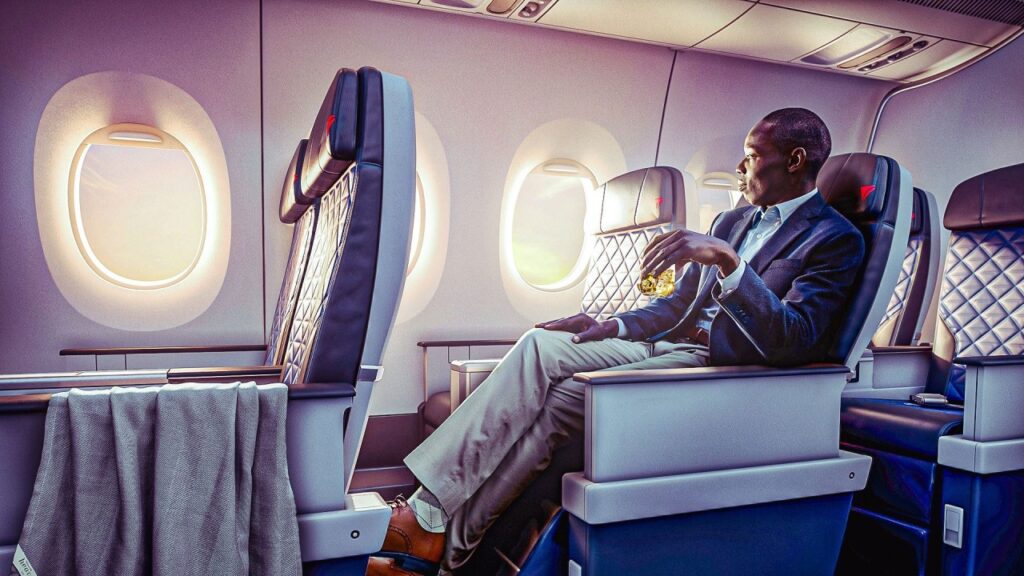
Delta Air Lines has doubled down on the “Halo Effect.” They realized that premium travelers don’t just want a seat; they want to feel like they are in a high-end social club.
Culinary Credibility: Partnerships with Chef José Andrés and Shake Shack create a “high-low” luxury mix that appeals to the modern traveler.
Aesthetic Dominance: The introduction of Missoni-designed amenity kits and Taittinger Champagne in Delta One suites isn’t just about the product; it’s about the Instagrammable moments that drive organic reach.
The Result: Delta consistently ranks in the top 15 of Fortune’s “Most Admired Companies.” They’ve turned a commodity service into a lifestyle brand.

IV. The Infrastructure: Starlink and the “Always-On” Flyer
Personalization is impossible without connectivity. The Lufthansa Group has set the 2026 standard by equipping its entire fleet of 850+ aircraft with Starlink.
This isn’t just about Netflix. It’s about the Travel ID. By offering free high-speed Wi-Fi to anyone with a Travel ID, Lufthansa is funneling millions of passengers into their data ecosystem. Once you are logged in, the airline can track your preferences in real-time, offering you a lounge upgrade the moment your flight is delayed or a meal preference based on your previous three trips.

V. The New Barriers: Trust, Safety, and the “Green” Tax
As we pivot toward data-driven marketing, two massive hurdles have emerged in 2026: Cybersecurity and Sustainability.
1. Trust-Based Marketing
With airlines collecting more personal data than ever, the threat landscape has exploded. Marketing teams are now “Security Storytellers.” They are winning by emphasizing Digital Safety as a brand pillar. If a traveler doesn’t trust your data handling, they won’t use your “personalized” app.
2. The End of “Vague Green”
The UK’s DMCCA and EU regulations have officially ended the era of “vague” environmental claims. In 2026, if you say your flight is “green,” you better have the carbon receipts. Marketing has shifted to Transparent Reporting. Airlines like Air France-KLM are now using AI to show passengers exactly how much SAF (Sustainable Aviation Fuel) was used for their specific flight.

VI. The LinkedIn Factor: The Human Face of Aviation
In 2026, B2B airline marketing has moved away from corporate logos and toward Personal Brands.
- 80% of B2B leads are now generated on LinkedIn.
- Thought Leader Ads (where a CEO’s or Consultant’s post is promoted rather than the brand page) are seeing 3x the engagement.
As a consultant, I’ve seen that the most successful campaigns of 2026 aren’t the ones with the biggest budgets, they are the ones where the leadership talks like a human. They share the struggles, the data “fails,” and the vision for a better sky.
6 Key Takeaways for the 2026 Strategy
- The “Middle” is Dead: You are either the most efficient (ULCC) or the most experiential (Premium). Trying to be “okay” at both is a recipe for bankruptcy.
- Data is the New Fuel: Your loyalty program is more valuable than your planes. Monetize the data through retail media networks like United’s Kinective.
- Friction is the Enemy: Use AI not to “chat” with customers, but to predict their needs. If a passenger’s bag is delayed, the app should offer them a voucher before they reach the carousel.
- Premium is for Everyone: Spirit’s “Go Comfy” proves that even budget travelers will pay for a better experience if it’s packaged correctly.
- Connectivity is Mandatory: High-speed Wi-Fi (Starlink) is no longer a perk; it’s the “hook” that brings passengers into your data ecosystem.
- Integrity is the Brand: In an era of deepfakes and greenwashing, radical transparency about your data security and your carbon footprint is your strongest marketing tool.

Conclusion: The Personal Touch in a Digital Sky
The strategic pivot of 2026 is a paradox. We are using more data, more AI, and more high-speed tech than ever before, but the goal is to make travel feel more human.
The airlines that are winning are the ones that use their tech to stay out of the way. They use data to remove the stress, premium touches to add joy, and transparent communication to build trust.
As we look toward 2027 and beyond, remember: The seat is just a place to sit. The experience is where the profit lives.