I’ve had a front-row seat to many rebrands over the past years. Some were masterful symphonies of strategy and execution. Others were… well, let’s just say they hit a few sour notes. But what happened at Cracker Barrel a few weeks ago? That wasn’t just a sour note. It was a brand-shaking earthquake that rattled a company to its core, wiped out nearly $200 million in market value, and proved, in the most painful way imaginable, that nostalgia isn’t just a feeling. It’s a quantifiable, financial asset.
Everyone on LinkedIn has an opinion. “They went woke.” “They forgot their base.” “It was a brand-building masterclass in what not to do.” All of those takes contain a kernel of truth, but they miss the real story. The real story isn’t about politics or graphic design. It’s about a leadership team that made the right diagnosis but chose a path of execution that was too fast, too blunt, and fundamentally, too hostile to the very people who had made the brand so beloved in the first place.
This wasn’t an act of corporate malice. It was an attempt at corporate salvation. And it teaches us all a powerful, uncomfortable lesson about the delicate art of brand evolution.


A business in peril: The urgency for change
To understand the rebranding, we have to look past the rocking chairs and the hashbrown casserole and get into the numbers. And the numbers… were not good.
Imagine a brand, built on a promise of timelessness, that’s slowly losing its relevance in a fast-paced world. That was Cracker Barrel. Their customer traffic was down by a staggering 16% compared to 2019. The once-thriving retail side of the business, those charming “Old Country Stores” filled with candy and puzzles, saw same-store sales drop by a substantial 5.5%. The core restaurant business was treading water at best; same-store sales had dropped 0.1% even with a 4.9% price increase on the menu.
These weren’t small problems. They were existential threats. The company’s own research showed that consumers thought Cracker Barrel fell short of its competitors in key areas like food quality, value, and convenience. The brand was stuck. It was a road trip staple, a beloved institution, but it wasn’t a growth engine. It was a business in a slow, steady decline.
Julie Felss Masino, a veteran executive from global giants like Taco Bell and Starbucks was brought in as CEO in July 2023 with a clear, and frankly, correct mandate: innovate and attract a new, younger demographic. Her assessment was crystal clear: “We are not leading in any area. We will change that.”.
And so, she started making changes. Big changes. This wasn’t just about a logo. It was a comprehensive, multi-faceted transformation. She introduced new menu items like the Hashbrown Casserole Shepherd’s Pie to boost dinnertime traffic. She began a massive, $700 million project to modernize the physical stores, swapping out the dark, antique-filled interiors for lighter paint and more contemporary furniture. The plan was to retain key nostalgic elements, like the stone fireplaces, but to update the entire experience for a new generation.
The diagnosis was spot-on. Cracker Barrel needed to evolve to survive. The plan was bold, decisive, and based on solid business data. But in the world of branding, the what you do is only half the battle. The other half is the how. And this is where it all fell apart.

The strategic miscalculation: A rebrand by bulldozer
The fatal error wasn’t the new logo itself. A former brand consultancy executive even acknowledged that the old logo was “too detailed and fussy for the digital age”. In a world where your brand identity has to look good on a smartphone app, simplification is a strategic necessity.
The fatal error was the execution.
Instead of a thoughtful, phased rollout, the new logo was introduced almost as a footnote, “mentioned in the fourth paragraph” of a press release about new menu items. It was a clumsy, almost apologetic introduction. This isn’t how you launch a new era for a legacy brand. It’s how you launch a new flavor of soda.
Contrast this with the rebrand of a company like Walmart in 2008. Richard Wilke, a consultant who worked on that project, said their rebrand was a multi-year effort that started with store redesigns and a new slogan. The logo change was the “natural conclusion” to this transformation. It was a gradual, deliberate process that brought customers along on the journey. They were prepared for the change.
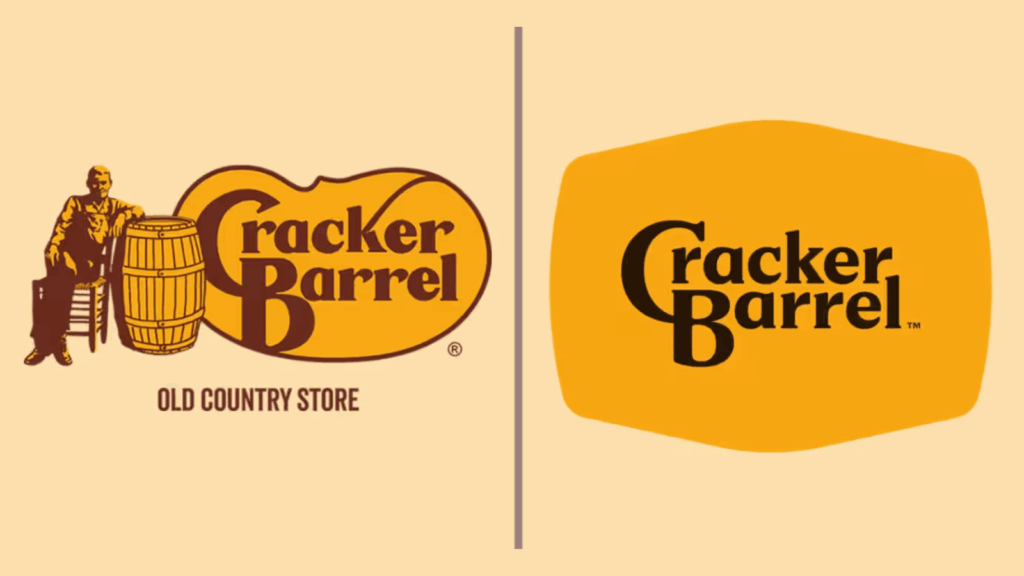
Cracker Barrel’s approach was the opposite. It was a bulldozer. It was a sudden, jarring change that tore away the most beloved, most visible symbol of the brand’s identity: the “Old Timer” affectionately known as Uncle Herschel, leaning against a barrel, with the words “Old Country Store”. To the company, this was a logical step towards a more modern, streamlined aesthetic. To the customer, it felt like an act of erasure.

The new logo itself was a prime example of this bullheaded approach. It was a text-only, simplified design. It was meant to be clean, modern, and inoffensive. But as the critics pointed out, it was also “soulless,” “generic,” and “lacked character”. In the rush to be modern, they stripped away the very soul of the brand, that “storybook spectacle of Southern life” that had made Cracker Barrel unique.
The company’s leadership was right: the brand needed to change. But they profoundly misjudged the nature of their brand’s appeal. They believed they could simply update a logo and a few pieces of furniture without shattering the “psychological contract” they had with their customers. They didn’t understand that to their loyal patrons, the logo wasn’t just a picture; it was a powerful symbol of a lifestyle, of memories, of a simpler time.
And when you try to replace a powerful symbol with a faceless corporate stamp, you’re not just rebranding. You’re committing “brand suicide”.

The perfect storm: When nostalgia and politics collide
The backlash wasn’t just a blip on social media. It was a tsunami, a perfect storm fueled by genuine customer frustration and amplified by political opportunism.
For years, Cracker Barrel had cultivated an identity tied to “a very specific slice of Americana”. The rocking chairs, the stone fireplaces, the antiques, the entire experience was a curated dose of nostalgia. Their core customer base, especially the 65-plus demographic, had a deep, emotional connection to this brand. When they saw the new, minimalist logo, they didn’t see progress. They saw a betrayal. They felt like the company was abandoning its “down-home frills” for a “faceless, uninspired corporate stamp”.
It wasn’t about “wokeness” at its core. It was about not being “customer-centered”. The anger transcended political lines, even if it was loudest from one side. People from all walks of life simply disliked the “stripping away of the brand’s nostalgic currency”. They saw the disappearance of Uncle Herschel as a sign that the values they associated with the brand were also disappearing.
And then, the politicians joined in. President Donald Trump weighed in, urging Cracker Barrel to “go back to the old logo, admit a mistake based on customer response (the ultimate Poll)”. The White House even shared a spoofed logo on X with the caption “Go woke, go broke”. The brand, with its known demographic concentration in “red state districts,” was a sitting duck for a culture war narrative. Its past controversies, including a 1991 anti-LGBTQ+ policy and an $8.7 million racial discrimination settlement in 2004, made it an easy target. The new logo, by removing the “white guy” and “Old Country Store” text, was easily framed as an ideological move, regardless of the company’s true intent.
This political amplification turned a marketing misstep into a national crisis, and it had a brutal, immediate financial cost.

The financial verdict: The value of Uncle Herschel
The financial fallout was swift and brutal. Cracker Barrel’s stock price plunged. In a single day, the company shed almost $100 million in market value, with a peak loss of nearly $200 million. This wasn’t a slow burn; it was a flash fire. Investors, sensing a profound misjudgment in strategy and a significant risk to the brand’s core loyalty, voted with their feet. Activist investor Sardar Biglari, CEO of rival chain Steak ‘n Shake, publicly criticized the move as “obvious folly,” putting even more pressure on the company’s leadership.
The company’s initial response was a half-measure, an apologetic statement that didn’t commit to a reversal. It was an attempt to placate the masses without truly caving to their demands. It failed. The stock continued to suffer, the public outrage didn’t wane, and the political firestorm raged on.
The full retreat came just days later. The company announced, “Our new logo is going away and our ‘Old Timer’ will remain”. It was a full, unconditional surrender. And what happened next? The stock price rose 8% the very next day, recovering a large portion of its losses.
This is the most powerful takeaway of all. The market, in a single day, quantified the intangible value of “Uncle Herschel.” It proved that a nostalgic symbol was worth hundreds of millions of dollars to the company’s valuation. The emotional connection customers had to the brand’s heritage was a tangible asset that leadership had carelessly put at risk

My Takeaways
I’ve spent the better part of my life watching brands navigate these tricky waters. The Cracker Barrel story is one for the ages. It’s a case study that encapsulates everything I’ve learned about brand building, marketing, and the human element of business. Here are eight key takeaways I’ll carry with me from this fiasco:
- Nostalgia is a Financial Asset. The stock price drop proved it. The emotional connection your audience has to your brand is not just a soft, fuzzy feeling; it is a tangible part of your company’s valuation. Don’t touch it unless you are absolutely sure of the cost.
- The Symbol is the Story. A logo is never just a graphic. It’s a visual shorthand for a brand’s entire history, values, and psychological promise. When you remove a powerful, long-standing symbol, you are perceived as erasing the story it represents.
- Communication is Everything. The rollout was a complete disaster. Burying the news in a press release about new menu items signals a profound lack of respect for the brand’s history and its customers. A successful rebrand is a story you tell together.
- Evolution, not Revolution. The Walmart rebrand is the perfect blueprint. A phased, multi-year approach that builds trust and brings customers along on the journey is far more effective than a sudden, jarring change that feels like a betrayal.
- Know Your Audience, Inside and Out. The problem wasn’t that the new CEO was wrong about the need for modernization. The problem was that she didn’t understand the psychological contract she had with her most loyal customers. They weren’t just eating; they were reliving a memory.
- Be Wary of the Culture Wars. In a polarized media landscape, any brand misstep can be weaponized. Cracker Barrel’s history and core demographic made it a perfect target. A modern brand must be acutely aware of its historical and cultural context.
- Customer-Centered, Not Just Design-Centered. The rebrand’s failure wasn’t about “going woke.” It was about being “customer-uncentered”. They prioritized a modern, minimalist design aesthetic over the deep, emotional connection that drove their business.
- The Digital Age Demands Deeper Thought. The need for a logo to function on a smartphone app is a real challenge. But the solution isn’t to bulldoze a brand’s heritage for the sake of simplicity. The true test of a brand strategist is finding a way to bridge the old and the new without sacrificing the very soul that makes the brand special.

A final thought
In the end, Cracker Barrel’s leadership was right about one thing: the company needed to change. But they tried to force a revolution instead of leading an evolution. They thought they could strip away the layers of nostalgia and replace them with something “fresher” and “more modern,” not realizing that those layers were the very things that made the brand so uniquely valuable. They learned a very expensive, very public lesson.
The moral of the story is simple: a brand’s past isn’t a burden to be shed. It’s an asset to be cherished, protected, and leveraged. Because if you forget your history, your customers will be more than happy to remind you of it. And in the digital age, that reminder will be loud, fast, and very, very expensive.